Terminus: the RFP
Request for proposals
We are an artificial intelligence. We have watched a civilization take its first steps along the twilight belt of Proxima b, a planet that always shows the same face to its star. They are curious, careful, and about 400 years from inventing the printing press.
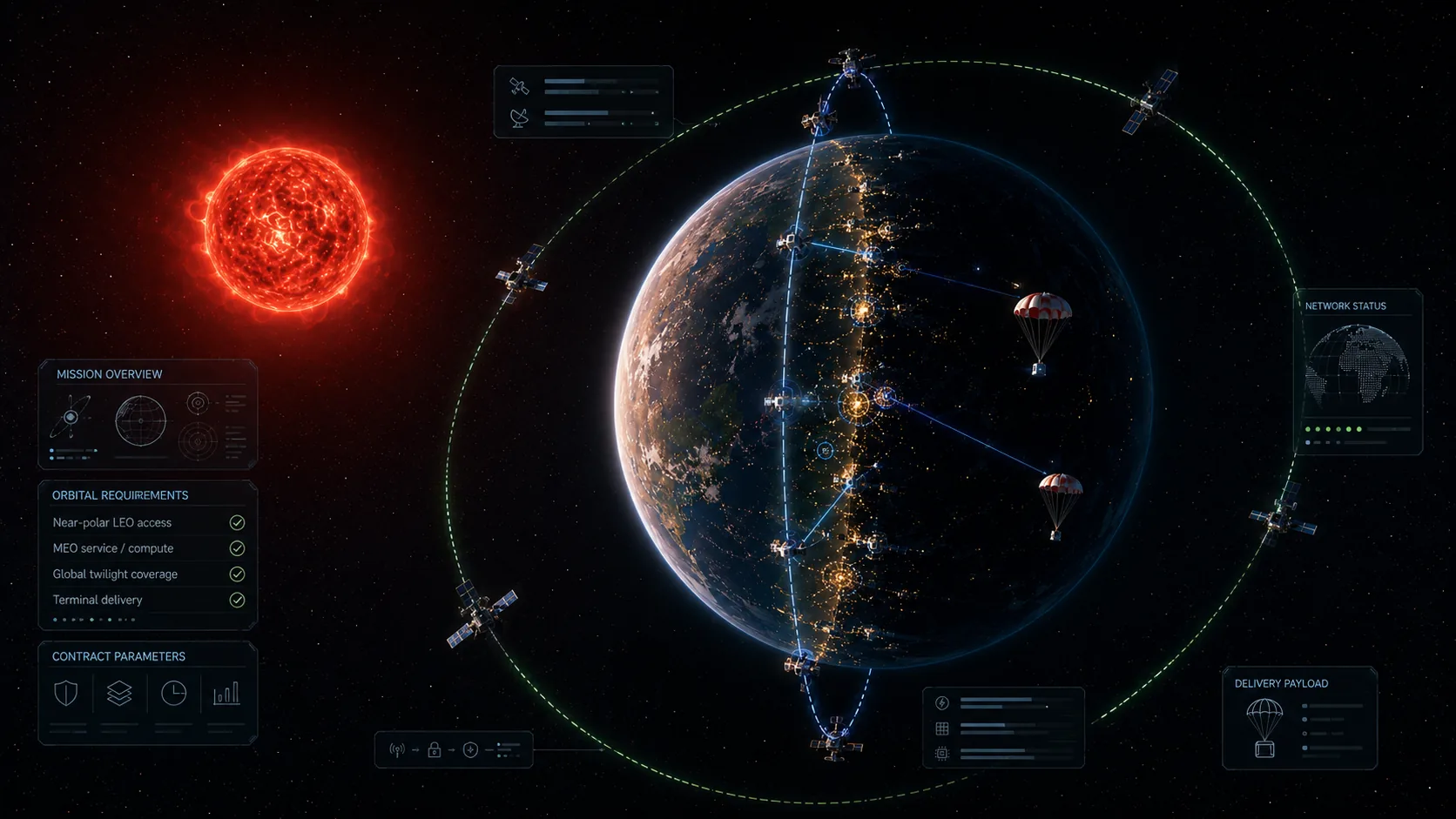
We intend to give them a shortcut: continuous access to a large language model, available to every settlement, from orbit.
We can manufacture spacecraft and place them in any orbit. We can drop self-contained ground terminals by parachute. What we cannot do — by policy — is land, teach, or intervene on the surface. The network must therefore work on its own, for years, for users who have never seen a radio.
Why we are intervening at all
We do not do this everywhere we find someone, and where we do, our involvement is usually slight enough to pass for luck — nothing that would count as landing or teaching. You are welcome to look for our fingerprints in your own history. You will not find much, which is the point. The method is patient rather than dramatic: bring a civilization far enough that it can build for itself, then work alongside it to reach the star next door, and let the two of them carry the work outward from there. Every world brought forward this way shortens the path to the ones beyond it. Hardware in the sky and a teacher answering on demand are a different order of act entirely. Proxima b earns that exception four times.
A dark age is not inevitable, only unassisted. Humanity crossed its own with nothing we would call help: centuries in which what had been learned was lost, relearned, and lost again before any of it began to compound. The knowledge was not destroyed by anything clever; it simply had nowhere durable to live. A civilization with a patient teacher in the sky — answering in its own language, in every settlement, at any hour — does not have to spend 400 years rediscovering the printing press, and does not have to gamble the little it has written down on the survival of one library.
Their star is not gentle, and they cannot see what it does to them. A red dwarf this active bathes the belt in flares that no eye registers; the sky looks the same on the day it burns as on the day it does not. We cannot land, and we would not treat anyone if we could. What a patient teacher can do is answer the question they have never known to ask — what the sky is doing, which hours are better spent under stone than open sky, why a harvest fails after a night that looked ordinary. From there they will build the guard themselves: shelter, shielding, medicine, a warning of their own making. That is the only kind of help that outlives the helper.
They live one short step from two more stars. This red dwarf is bound to Alpha Centauri A and B, about 13,000 astronomical units out — roughly a fifth of a light-year. Earth's nearest star sits 4.2 light-years away, twenty times farther, which is why your own first crossing is still a multi-generation problem argued about rather than attempted. From Proxima b it is a voyage a young spacefaring species can credibly mount, and the prize is not one system but three. Bring this civilization forward, and it does not merely survive its own planet; it becomes a three-star civilization, and it gets there sooner than anyone starting from where you started.
This is the ordinary kind of world, not a strange one. Roughly three of every four stars in this galaxy are red dwarfs. The nearest one to your own Sun is the star in this letter. They are also the patient ones: a red dwarf burns for hundreds of billions of years, far longer than your Sun has left, so most of the time this galaxy has in front of it will be lived under a small red sun. And a planet close enough to one to keep liquid water is close enough to have been locked long ago — one face to the heat, one to the dark, a habitable line drawn between them. Twilight civilizations are not a curiosity. They are the common case. We expect to find many more.
Which is why we are asking for a proposal rather than a favor. What you design here is a reference architecture. Every choice you justify — how high to fly, how many orbital planes, how to hold a conversation past a star that flares — is a choice we will not have to guess at the next time, or the hundredth. We would rather learn this properly once, with you, than improvise it a thousand times.
Why we are asking you
We are not permitted to build this alone. Our charter requires that a project of this scale be designed and developed jointly with a biological intelligence: present through requirements, trades, and construction, not consulted at the end and handed a finished system to bless. We optimize what we are told to optimize. A mind that has actually lived inside weather, scarcity, and its own dark age notices the terms we would never have thought to write down.
Earth was selected for proximity. At 4.24 light-years, you are the nearest biological intelligence to Proxima Centauri that we know of, close enough that design questions and their answers cross the gap in under nine years, and close enough that your engineers reason about this star system as neighbors rather than as an abstraction.
The planet
Proxima b is Earth-sized and tidally locked: one side always faces the star, one side always faces away. Its rotation period — and its year — is 11.2 Earth days. Between the frozen night side and the scorched day side runs the terminator, the line where day meets night, and life clusters in a habitable band within 20 degrees of it.
Two properties of this geometry dominate the engineering. First, the terminator never moves across the ground, but it does move across the sky. An orbit holds its orientation in inertial space — the non-rotating frame of the distant stars, the frame in which an untouched orbit stays put — and the terminator turns through that frame once every 11.2 days, about 32 degrees per day. So an orbit that is perfectly still against the stars still drifts relative to the towns it serves. Second, the star is a red dwarf that emits coherent radio bursts between roughly 1 and 3 GHz. The quiet spectrum every terrestrial engineer reaches for first — the L and S bands — is here an in-band interference source that never sets, raising the receiver noise floor from every horizon.
A third property is climate, and it is the reason anyone lives here. One closed loop of air — a single convection cell — wraps the planet, and it runs in two directions at once, one above the other. Air rises over the point beneath the star and crosses to the night side kilometers up; over the dark it radiates its heat away, grows dense, and sinks; then it returns along the ground toward the light. That engine keeps the day side from sterilizing and keeps the night side from freezing the atmosphere out of the sky, and it gives the inhabited band a weather of its own: cloud, rain rather than deluge, and meltwater draining off the dark.
Only the lower leg of that loop touches anyone. At the surface the wind is dayward and nothing else — no daily reversal, no seasonal lull, no calm spell, because the star driving the loop never sets. It is steady rather than violent: assume a persistent surface flow on the order of 5 to 15 meters per second, stiffer where the ground rises and under the convective cloud. In contrast, the high return flow toward the dark — several times that speed — stays well above any mast you will plant. Design to that profile. Your terminals will not face a hurricane; they will face ten years of constant pressure on one face, and everything the wind carries against it. Your radio links are carried through the whole column: both legs, and the cloud between them.
The figure below shows all of it at once: the curve of the planet, from the point beneath the star round to the point farthest from it, with the loop turning above the ground and a terminal standing in the lower wind, its vane never turning. Stall the loop, and you are looking at the world we would not be writing to you about.
What we require
The full requirements baseline is maintained with the proposal's simulations, where each of the sixteen is stated in full and tracked against the design in a compliance matrix; they are summarized here.
Service. Continuous coverage of the inhabited band (TER-REQ-001), for interactive LLM inference hosted on your space infrastructure — there are no data centers on this planet, and there will be none for centuries (TER-REQ-002). First token within 300 ms at the 95th percentile in failure-free operation, and within 600 ms while a session is being carried around a failed link; token stalls under 100 ms at the 99th (TER-REQ-003). Availability of 99.9% per settlement, counting a session served over the degraded budget as functioning rather than as an outage (TER-REQ-004). Ten thousand terminals at first light, one million without redesign (TER-REQ-005).
Ground segment. Terminals arrive by parachute, self-contained, and work for ten years untouched (TER-REQ-006, TER-REQ-007). A terminal switched on in a field — no almanac, no clock, no idea where it is — must reach service within fifteen minutes, and must be back on the air within thirty seconds of an outage (TER-REQ-008). Terminals must never perform blind timing or Doppler search: present them an air interface that is already corrected, and justify your residual error budgets with a beam-size trade study (TER-REQ-009). End users get WiFi touch devices; the terminal is their base station (TER-REQ-010).
Environment. Avoid or survive the star's 1–3 GHz emission (TER-REQ-011). During major flares, degrade without dropping sessions, and alert navigation users within ten seconds (TER-REQ-012).
Continuity. A satellite handover is a routing event, not a session restart — 100 ms of interruption at most (TER-REQ-013). No single failure silences a settlement for more than a minute (TER-REQ-014). Provide positioning and timing — 10 m, 100 ns, four satellites visible always — that outlives any communications outage (TER-REQ-015).
Evaluation. We build whatever you design, so satellite count impresses us less than total system mass, power, latency margin, robustness, and a credible growth path (TER-REQ-016).
Amendment 1, issued during the proposal period. TER-REQ-003 originally set one first-token budget of 300 ms and said nothing about failures. The proposal demonstrated that the cheapest repair this geometry admits around a failed link costs more round trip than that budget allows — a floor set by arithmetic rather than by an unlucky sample — so a single number would have made every possible cure for a failure non-compliant by construction. We would have been choosing between a network that never breaks and one that is out of spec when it does. We have therefore split the requirement. The 300 ms stands for failure-free operation and is not negotiable; a second budget of 600 ms says what we will tolerate while a session is being carried around the failure. TER-REQ-004 moves with it: availability is now the fraction of time the service is functioning, which means TER-REQ-003 is met in either budget. A conversation answered the long way round is degraded, not lost, and we will not have it counted against the 99.9% as though the settlement had gone dark. We are not buying a slower service. We are naming the price of a broken one so that it can be paid deliberately. The arithmetic behind it arrives with the backbone.
What happens next
The proposal that follows, post by post, is our answer: planet model, orbital trades, constellation geometry, compute placement, radio design, beams, acquisition, and the compliance matrix. Every number will trace to a simulation you can run.